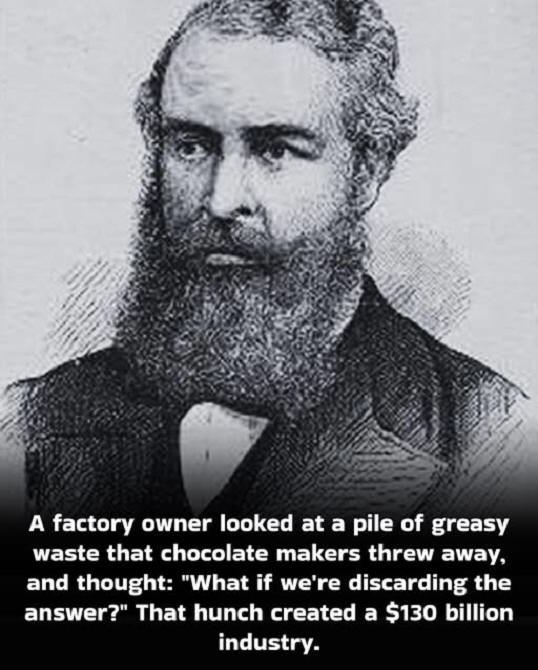
Bristol, England. 1847.
Joseph Fry stood in his chocolate factory, staring at a problem that was
driving the entire industry mad.
For over 3,000 years—since the ancient Maya and Aztec civilizations—chocolate
had been a beverage. A bitter, gritty drink mixed with water or milk, consumed
by nobles and priests in elaborate ceremonies. The Spanish brought it to
Europe in the 1500s, where it became a luxury drink for the wealthy, sweetened
with sugar and served in ornate cups.
But it was still just a drink. Always a drink.
The chocolate itself was thick, fatty, difficult to work with. When you tried
to eat it solid, it was grainy and unpleasant, leaving a coating of grease in
your mouth. The cocoa butter—the natural fat in cacao beans—made it impossible
to create anything that felt good to eat.
Everyone understood this was just how chocolate worked. You drank it. You
didn't eat it.
Then, in 1828, a Dutch chemist named Coenraad van Houten (and his father
Casparus) changed everything by accident.
They invented a hydraulic press—a machine that could squeeze cocoa beans with
enormous force, separating the components that had always been mixed together.
On one side of the press: fine cocoa powder, lighter and less fatty.
On the other side: pure cocoa butter, a yellowish-white fat that poured out
like oil.
The chocolate industry immediately recognized the value of the powder. It made
better drinking chocolate—smoother, easier to mix with water or milk, less
greasy. Van Houten's "Dutch process" cocoa became the new standard.
But the cocoa butter?
Most manufacturers saw it as waste. A byproduct. Some sold it to pharmacists
who used it in ointments and medications. Some threw it away. It was too
fatty, too heavy, too rich. Its melting point was too high to be useful.
It was the problem they'd been trying to solve, now sitting in barrels like
industrial runoff.
For nearly 20 years, chocolate makers used Van Houten's press to make better
drinking chocolate. They extracted the butter, kept the powder, and considered
the problem solved.
Joseph Fry saw something different.
He was a Quaker businessman running his family's chocolate company in Bristol.
The Frys had been making chocolate since 1761—almost a century of grinding
beans, mixing drinks, serving the wealthy elite. But Fry wasn't content with
tradition. He was looking at the mechanics of the business, the chemistry of
the product, the opportunity everyone else was missing.
Think about what he saw:
Everyone was removing cocoa butter to make powder for drinking.
But what if you added it back in—controlled amounts, precise ratios—along with
sugar?
What if the "problem" was actually the solution?
It was counterintuitive. The entire industry had spent decades trying to
remove fat from chocolate. Fry was proposing to add it back.
His competitors thought he was wasting time and money. The cocoa butter was
worthless. Everyone knew that. It was too fatty, too rich, too... much.
But Fry experimented anyway.
He took the separated cocoa butter—liquid at certain temperatures—and melted
it down. Then he mixed it back into cocoa powder, adding sugar to cut the
bitterness. He adjusted ratios. Tested temperatures. Refined the process.
The chemistry was simple: cocoa butter is a fat that's solid at room
temperature but melts around 93-97°F—just below human body temperature. When
properly mixed with cocoa solids and sugar, it creates a substance that's firm
enough to hold a shape but melts in your mouth.
But nobody had balanced the equation quite like this before.
The result was a thick, smooth paste.
Not liquid. Not powder. Something entirely new.
Fry poured it into molds—rectangular ones, designed for easy storage and
transport. Then he cooled it.
When it solidified, he had something revolutionary: a bar.
A bar that didn't crumble when you bit it.
A bar that snapped cleanly when you broke it.
A bar that melted on your tongue, releasing flavor instead of leaving grease
behind.
Joseph Fry had just invented solid eating chocolate.
Not "chocolate for making drinks." Not "chocolate flavoring." But chocolate as
a thing you could hold in your hand, break off a piece, and eat directly.
It was called "Chocolat Délicieux à Manger"—Delicious Chocolate for Eating.
This wasn't an improvement on drinking chocolate. It was a completely
different product. A new category. An invention that would transform an
ancient beverage into the world's most popular snack.
And it only existed because Fry looked at what everyone else was throwing away
and asked: what if this is exactly what we need?
By 1853, Fry's company had refined the process enough to create Fry's Cream
Sticks—the first filled chocolate candy made on a factory scale. Chocolate on
the outside, flavored cream on the inside.
By 1866, they launched Fry's Chocolate Cream—a fondant-filled chocolate bar
that became the first mass-produced chocolate bar in the world. It's still
being made today, 158 years later, the oldest chocolate bar brand still in
production.
But the real revolution was what came next.
Once Fry proved that solid chocolate bars were possible—and
profitable—everyone else started experimenting:
1875: Daniel Peter in Switzerland mixed condensed milk into chocolate,
creating milk chocolate.
1879: Rodolphe Lindt invented the conching process, making chocolate even
smoother and creamier.
1900: Milton Hershey created the first American mass-market chocolate bar.
1920s-1930s: Filled chocolate bars exploded—Milky Way (1923), Snickers (1930),
Kit Kat (1935).
The chocolate bar became a global phenomenon. Portable, affordable,
individually wrapped. Soldiers carried them in wars. Kids bought them with
pocket money. They became movie snacks, road trip staples, comfort food,
gifts, rewards, treats.
Today, the global chocolate industry is worth over $130 billion annually.
Think about that number. $130 billion. Every year.
Chocolate bars, chocolate chips, chocolate candy, chocolate everything—it all
traces back to 1847, to a factory in Bristol, to a businessman who looked at
cocoa butter and thought: "What if we're throwing away the answer?"
Before Fry's invention, chocolate was an elite beverage. Expensive. Formal.
Served in cups at fancy gatherings.
After Fry's invention, chocolate became democratic. You could buy a bar for
pennies. Carry it in your pocket. Share it with friends. It was yours,
portable, personal.
Fry took a luxury drink and made it a snack.
He took a manufacturing problem and made it the solution.
He took a waste product and made it the key ingredient.
And he did it by asking a question nobody else was asking: "What if the thing
we're discarding is exactly what we need?"
Here's what makes this story extraordinary:
The insight wasn't complex. Mix the fat back in. That's it. That's the
innovation.
But nobody else saw it because they were all solving for the wrong problem.
They wanted to remove fat to make better drinks. Fry wanted to use fat to make
something entirely new.
Innovation isn't always about inventing something radically different.
Sometimes it's about seeing value where everyone else sees waste.
The Van Houtens invented a press that separated chocolate into parts. That was
brilliant engineering.
But Fry invented the idea that those parts should be recombined in new ratios
for a new purpose. That was revolutionary thinking.
He didn't just make a better chocolate drink. He created an entirely new way
to consume chocolate—and in doing so, he created an entirely new industry.
Every chocolate bar you've ever eaten exists because one man in 1847 looked at
barrels of cocoa butter that everyone else considered worthless and thought:
"What if this is treasure?"
The Maya drank chocolate in ceremonies 3,000 years ago.
The Aztecs served it to warriors and nobles.
The Spanish brought it to Europe as an exotic luxury.
For millennia, it was always liquid. Always a drink.
Until Joseph Fry mixed the butter back into the powder and discovered you
could hold chocolate in your hand.
In honor of Joseph Fry (1767-1835) and his sons who revolutionized his
company, who proved that sometimes the answer is right there in the waste
barrel, who turned a byproduct into an icon, who took a drink and made it a
snack, who created the chocolate bar—and with it, an industry that brings joy
to billions of people every single day.